In some of the world’s most challenging environments, pitcher plants thrive where few others can.
While many are famous for trapping insects, these plants also showcase remarkable adaptations: from evolving specialized shapes at different life stages to developing viscous fluids that make escape nearly impossible.
Some species even grow large enough to catch small vertebrates, all while surviving in soils too poor for most plants.
In this blog, we’ll explore the extraordinary strategies that allow pitcher plants to survive and thrive against the odds.
Nature’s Ingenious Survivors in Harsh Environments
1. Pitcher plants can live in soil too poor for most plants, surviving where others cannot.
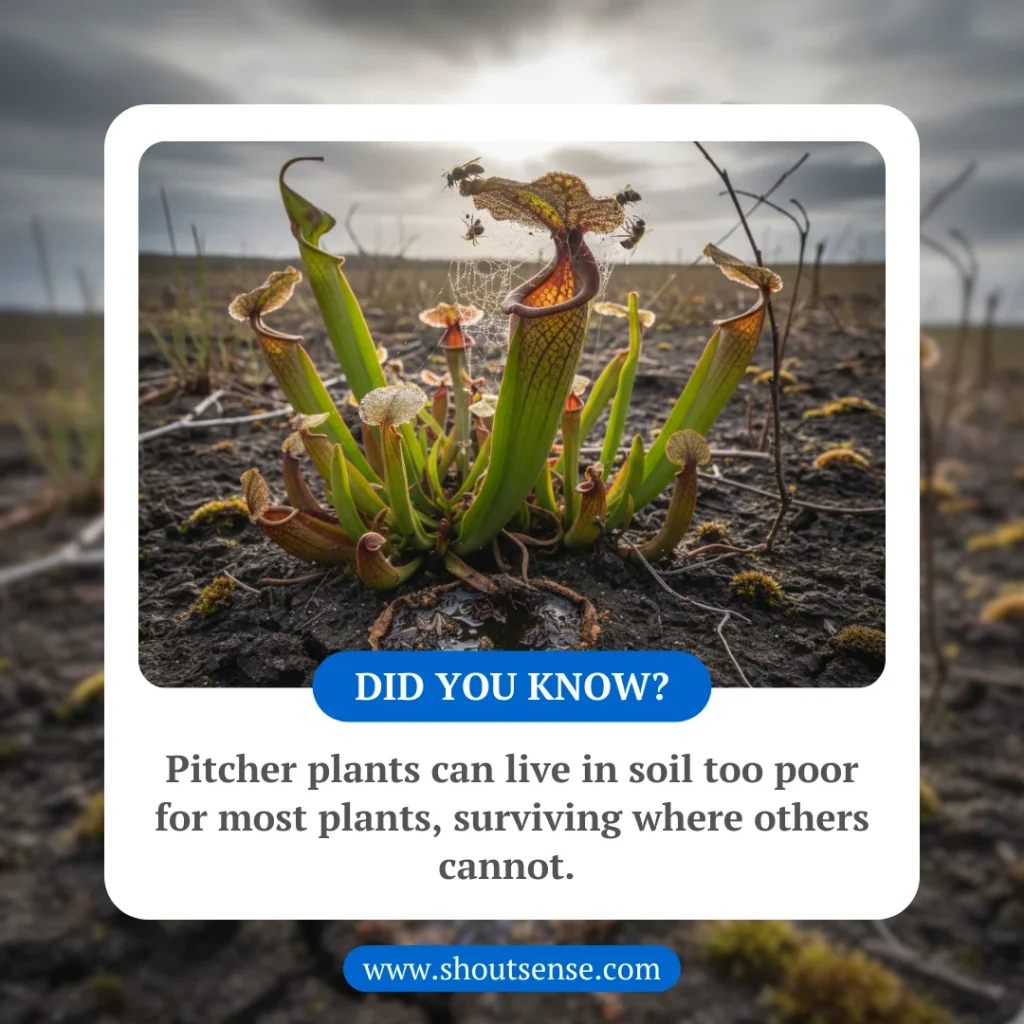
Pitcher plants survive in nutrient-poor soil, and sometimes acidic soil, where other plants can’t survive.
To adjust, they evolved carnivory, using their traps to supplement necessary nutrients such as nitrogen and phosphorus, which are limited in the soil.
By trapping and digesting insects, pitcher plants gain additional nutrition that the plant can’t get through its soil.
Hence, even in poor soil, these pitcher plants can survive due to their ability to trap insects as a source of nutrients.
2. They have different shapes at different ages, designed to trap different kinds of prey.
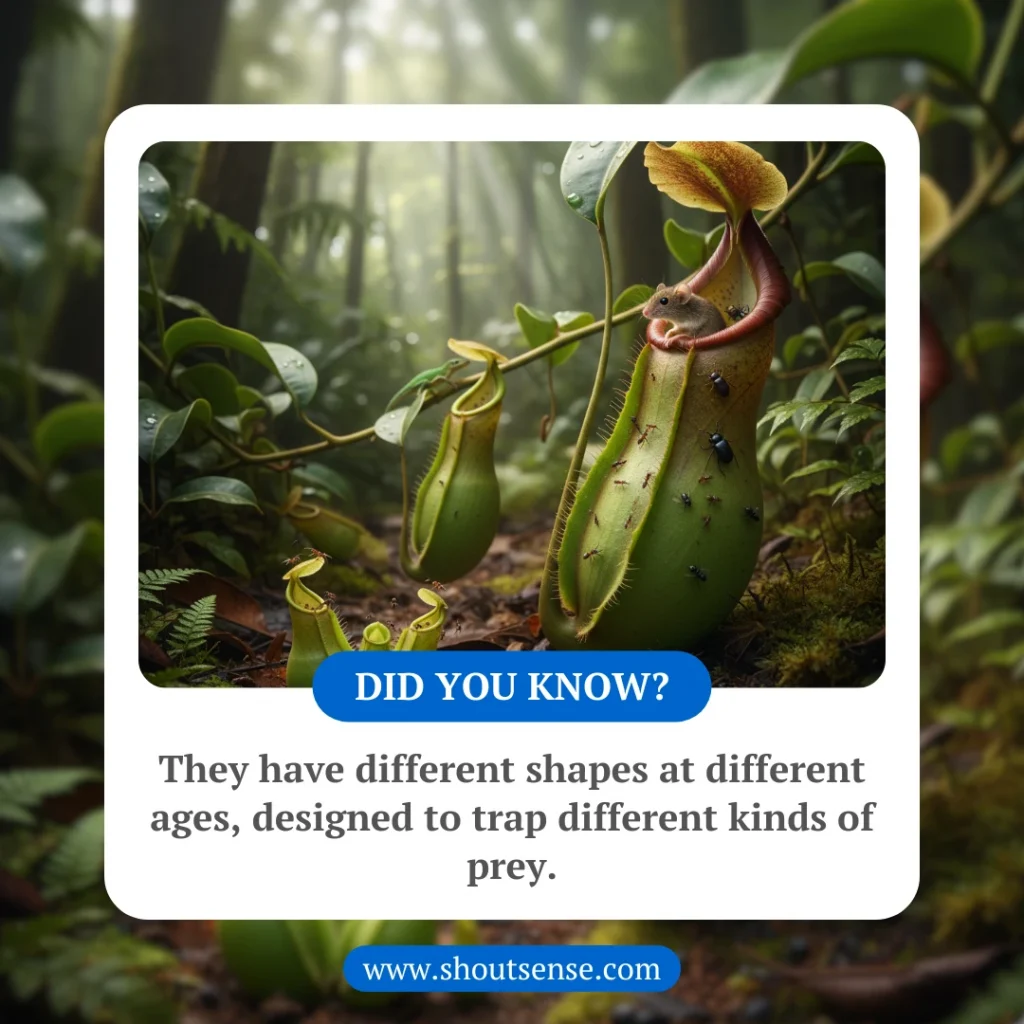
Many pitcher plants, especially in the genus Nepenthes, change their pitcher shape as they grow.
Young pitchers are smaller and specialized in catching ants and other small prey.
As the plant grows, it could trap bigger insects and even small vertebrates.
The pitcher’s shape and position have a major role in catching their prey.
Its size and shape match the size of the prey it most often catches, which shows its unique trapping design.
3. Insects often struggle for minutes before sinking, wasting all their energy.
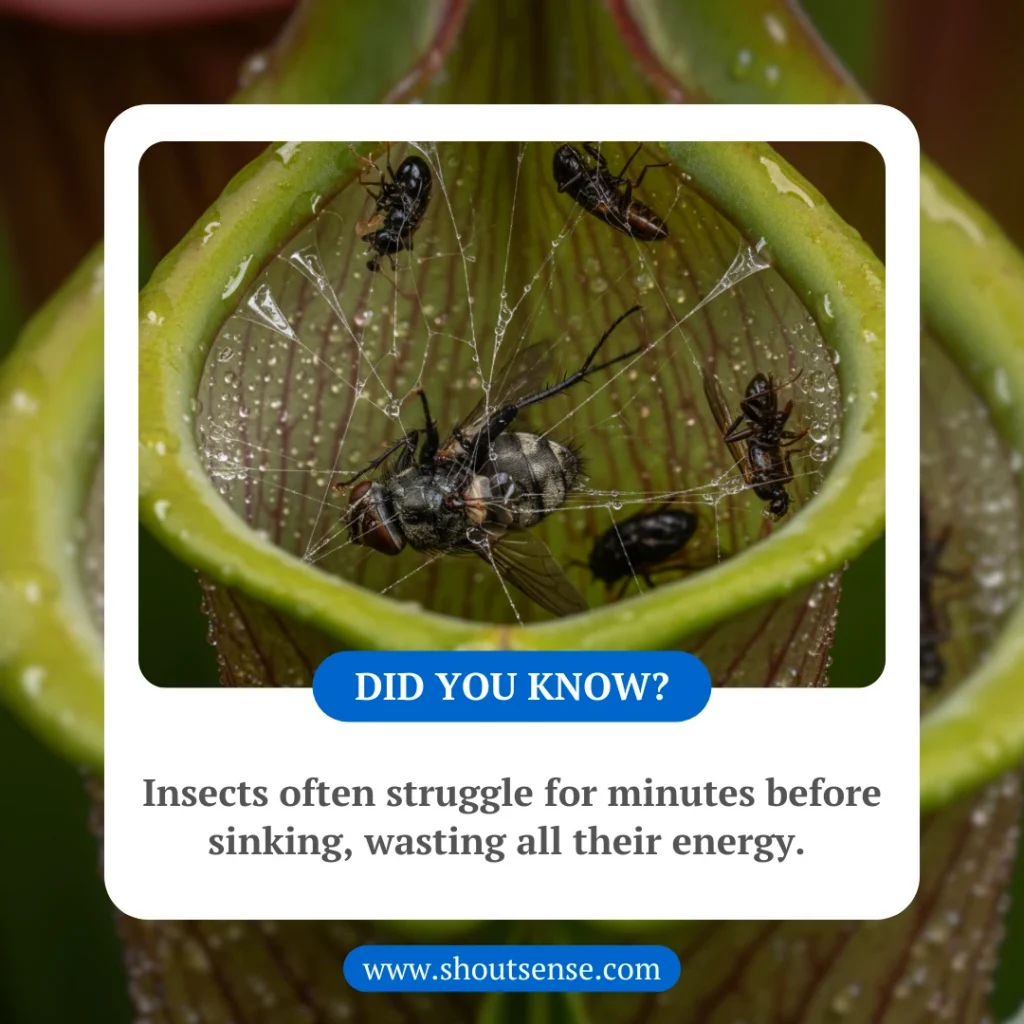
Pitcher plants produce a sticky, viscoelastic fluid, which makes it nearly impossible for insects to escape once they fall inside.
The fluid works in three ways.
First, it has lower surface tension than water, which means insects will sink and drown more easily.
Second, the captured insects, when in fluid, need more energy to pull themselves out; however, it’s difficult for them to escape.
Lastly, the fluid holds tightly to the insect’s body and leaves behind residues, which makes the insect reattach easily.
All these features of pitcher plants ensure that insects or even prey stay trapped inside and eventually are digested.
4. Certain species are large enough to hold more than two liters of fluid.
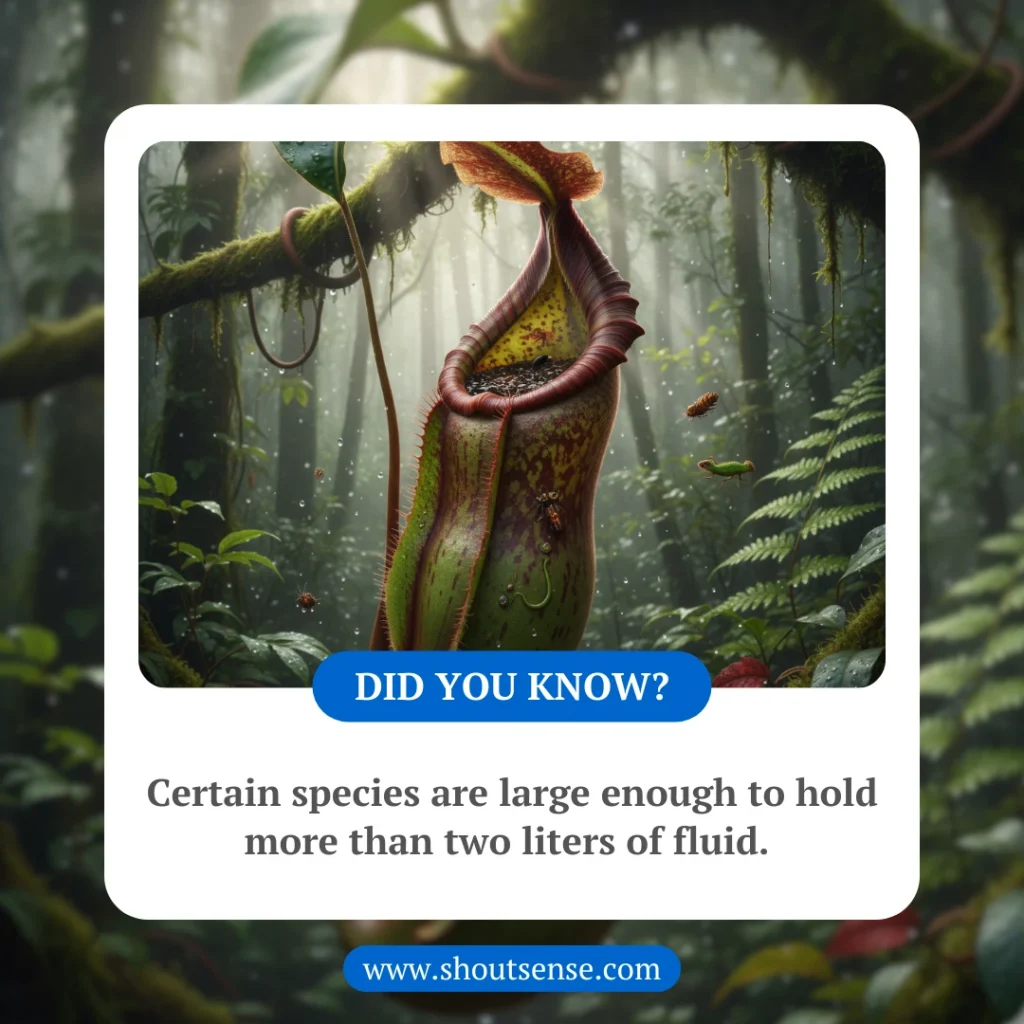
Some pitchers, especially Nepenthes rajah, are known for producing the largest pitchers in the genus.
Its urn-shaped traps can grow up to 41 cm tall and 20 cm wide.
These pitchers are capable of holding up to 3.5 liters of liquid, including more than 2.5 liters of digestive fluid.
This large volume of liquid enables the plants to catch not only insects but also small vertebrates such as lizards and rodents.
This structure makes pitcher plants one of the most remarkable carnivorous plants in the world.
5. Pitcher plants are ancient survivors that have been around since prehistoric rainforests.
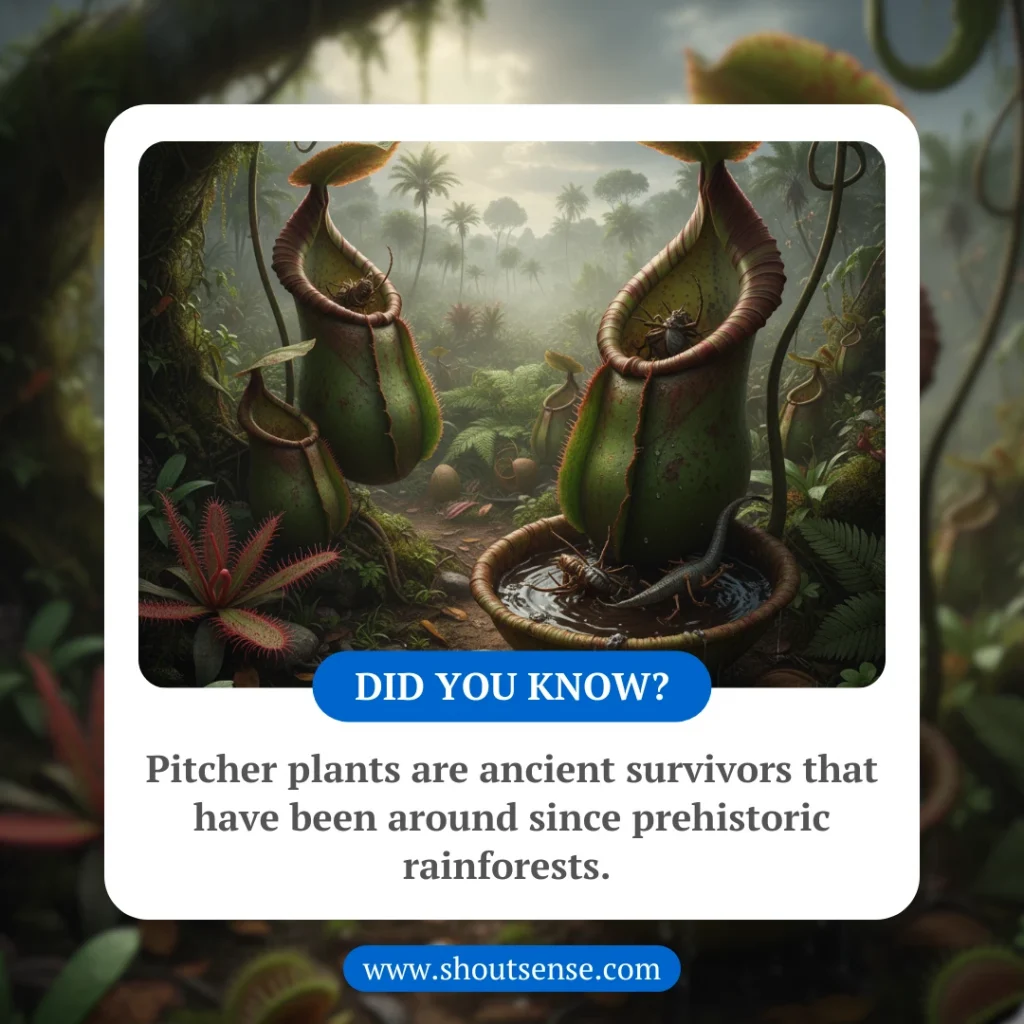
Pitcher plants have been evolving for millions of years, and their origin is estimated between 8 and 72 million years ago.
These plants grow in nutrient-poor soils, which is common in both ancient and our modern rainforests, where important nutrients like nitrogen and phosphorus are lacking.
To survive, they adapted leaf structures, such as pitcher traps, to lure, capture, and digest insects, making them a source of nutrients.
The DNA sequence phylogenies show that carnivory in plants has evolved independently at least nine times.
For instance, pitfall traps (Pitcher Plant) evolved six times, sticky traps (Flypaper Plants) five times, snap traps (Venus Trap) twice, and lobster-pot traps (Corkscrew Plants) only once.
These evolutions help them survive on different plant lineages.
Wrap-Up
Pitcher plants are master survivors, combining ancient evolutionary tricks with clever physical and chemical adaptations.
From their shape-shifting pitchers to their sticky digestive fluids, these plants reveal the ingenuity of nature.
They are living reminders that survival often means turning limitations—like poor soil—into opportunities for innovation.
Fascinated by how pitcher plants survive where other plants cannot?
Drop a comment and share which adaptation amazed you the most! Let’s dive deeper into the secret lives of these incredible carnivorous plants together.
For more random fun facts, visit here.